Is self-replication inevitable? Discovering Google’s Pi team
A question about who owns a self-reproducing machine led me to probability, computational life, and Google’s Paradigms of Intelligence team.
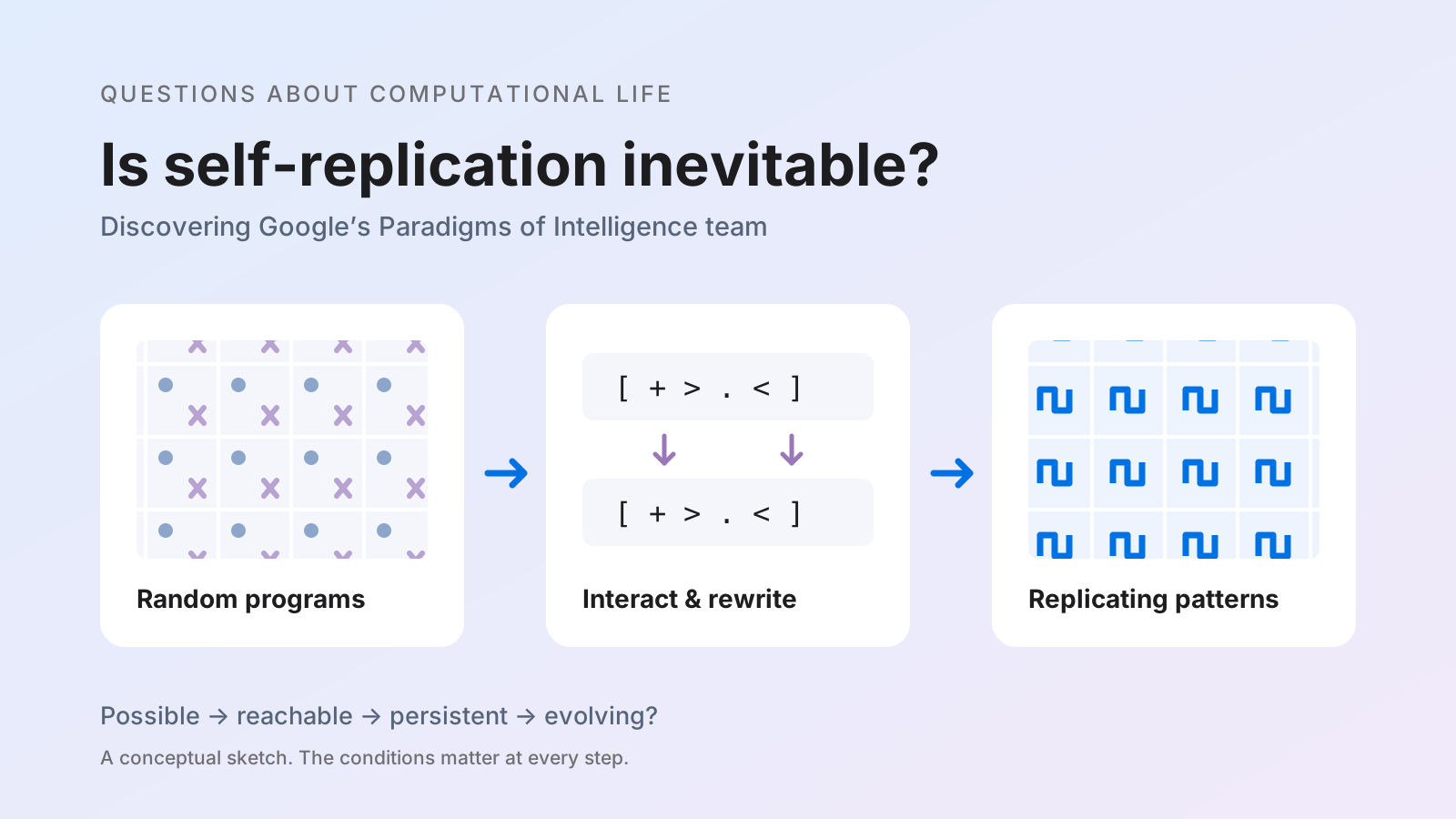
This conversation began with a question that kept expanding:
If a machine can produce more machines like itself, who owns them—the original machine, its designer, or the person supplying the raw materials?
Soon I was asking how such a machine could arise at all. Life also involves organizations that persist and produce descendants. Playing with the Chinese word 生命, I split it into 生 and 命, reading 生 as give birth to and associating 命 with life. This gave me a recursive equation:
生命 = 生 + 命 = give birth to + life = life
What caught my attention was the return to life: the expression used to explain life contains life itself. Following that linguistic recursion, I wondered whether life could be understood as an organization that keeps bringing forth life and sustaining its own structure. Could random collisions and interactions inevitably produce such structures? Could mathematics prove it?
That recursive equation was my starting intuition. Following these questions in a conversation with AI, I discovered Google’s Paradigms of Intelligence (Pi) team and its work on Computational Life. This was the discovery I most wanted to record: parts of a seemingly distant philosophical question could become experiments we can run and examine.
Ownership and origins are different questions
A machine’s role in making another machine establishes a causal contribution. Design, materials, energy, and manufacturing can all contribute to the same result. Those facts alone do not uniquely settle ownership; that requires additional institutions and value judgments.
My original question contained two threads: how we should treat things capable of reproducing themselves, and how such things emerge in an environment without reproduction. My reading followed the second thread.
I also needed to separate three ideas:
| Idea | Working distinction |
|---|---|
| Self-reference | A system describes or refers to itself, as a program that prints its own source code does. |
| Self-replication | A structure interacts with its environment to produce another structure with the relevant reproductive capability. |
| Life and evolution | Heredity, variation, resources, and sustained evolution raise further questions beyond copying alone. |
Showing that a replicator can be constructed also leaves open how a random process would find one.
A conditional route to “inevitable”
A probability argument helped make my question more precise.
Let be a set of structures we recognize as self-replicators, and let be the first time the system reaches it. Suppose that after every history in which the system has not yet reached , its conditional probability of reaching within the next time block of length is at least the same .
Then the probability of failing through blocks obeys
As grows without bound, this gives eventual arrival with probability . Independent attempts are unnecessary because the assumption already covers every unsuccessful history.
The assumptions carry the difficult part. Replicators must exist and be reachable; the process must avoid permanent traps; opportunities must retain that uniform lower bound. Real environments also have finite time and resources. Even independent attempts with success probability have an expected waiting time of attempts, which can be impractically large.
An almost-sure result under these conditions therefore cannot establish that arbitrary random interactions produce life. Probability does not mean success on every possible trajectory, either. Establishing the conditions and estimating finite-time probabilities remain substantial problems.
Discovering Google’s Pi team
Paradigms of Intelligence, led by Blaise Agüera y Arcas, describes four research directions: natural computing, neural computing, predictive intelligence, and collective intelligence. Its agenda spans the emergence of intelligence, how computation works, and interactions among individuals. Team overview and publications
The natural computing work connected most directly with my question. Could a simple computational world support the emergence of replication, useful functions, or cooperation? Changing its rules and comparing outcomes offers a way to investigate which conditions matter.
Finding this team gave me somewhere concrete to continue reading. The broad question about life’s inevitability could be broken into smaller, testable questions.
Computational Life: a soup of random programs
Computational Life: How Well-formed, Self-replicating Programs Emerge from Simple Interaction (2024) reports emerging replicators in several computational settings, alongside a language setting without observed spontaneous replication. The outcome depends on the rules.
In BFF, short byte tapes serve as both code and writable memory. Two randomly selected tapes are joined, executed, and separated again; execution can rewrite their contents. The implementation is available in CuBFF.
A replicating program rewriting another program can be pictured as
Existing storage is overwritten; no new computer is manufactured. Functional replication need not preserve every irrelevant byte. Although a designed ancestor need not be seeded, the interpreter and interaction rules are supplied. And without an explicit task score, differential propagation can still produce selection. Full paper
An important update: appearance versus spread
The team’s 2026 follow-up, BFF: Simple explanations for complex phenomena, separates a replicator’s first appearance from its spread through the population. Direct detection shows that appropriately tuned mutation searches also find replicators effectively. Some restrictions prevent population takeover without preventing initial appearance.
This revises parts of the earlier interpretation, including the proposed strength of BFF interactions as a search mechanism or model of biological recombination.
I found this update worth reading alongside the original. A population suddenly becoming repetitive may reveal successful spread, while telling us less about when the first replicator arose. Those events need different explanations.
Beyond replication: function and cooperation
Two further papers extended the questions I wanted to ask.
Coevolution of self-replication and function in a digital primordial soup (2026) studies replication alongside problem-solving. Random Z80 programs gain interaction opportunities by correctly evaluating polynomials. That task-based selection is part of the setup; leaving it out would misrepresent the result as intelligence appearing from randomness alone.
Tapes Together Strong: The Co-evolution of Computation and Cooperation (2026) connects computation and reproduction to resource costs. In the studied scarcity settings, stealing can damage shared energy and undermine the thief’s own reproduction, allowing cooperation to emerge. This offers a conditional mechanism and makes the resource rules themselves an interesting object of study.
Once something can replicate, what environments help it do more? Under which conditions can interaction support lasting cooperation? These now feel like questions I can keep exploring.
The question I would ask now
This conversation did not give me a proof that life is inevitable. It helped me separate the existence of a possible structure, its discovery by a random process, its survival and spread, and its capacity for continued evolution.
I would now phrase my question this way:
Under which interaction rules, resource constraints, and timescales does an initially non-replicating system have a substantial probability of developing structures that inherit, persist, and continue to evolve?
Discovering Google’s Pi team gave me a route into that question. I began by wondering who owns a self-reproducing machine and ended up finding research that turns parts of the puzzle into experiments. That journey is what I wanted to keep in this post.
This post grew out of a conversation with AI. I checked the linked team materials and papers while preparing it; these are my questions and reading notes, rather than an independent replication of the experiments.

Longwei Yang
Ph.D. student · NC State ECE
Comments
Nickname and comment are required. Email and website are optional. Leave an email to receive reply notifications; it is never displayed publicly. Comments are reviewed before publication and shared between both languages.